How to Hire — and Become — the founding account executive, Not Just a Sales Rep

TL;DR:
The Founding Account Executive isn’t just your first sales hire. They are the architect of your entire revenue motion. In 2026, hiring the wrong person into this role—or taking the role for the wrong reasons—is one of the most expensive mistakes a startup can make. Whether you’re hiring or considering the job, here’s how to know if the timing is right, what excellence actually looks like, and how to evaluate fit on both sides.


What the Founding Account Executive Really Is (and What It Isn’t)

In today’s capital-efficient market, the Founding Account Executive has evolved far beyond “quota carrier.”

For founders, this role is a force multiplier.
For candidates, it’s closer to a startup operator role than a traditional AE job.

A true Founding AE is a full-stack GTM builder. They don’t just close deals—they help define:

  • The ideal customer profile
  • Early messaging and positioning
  • Pricing and packaging feedback
  • What the first repeatable sales motion even looks like

Unlike AEs at later-stage companies, there is no inbound engine, no polished playbook, and no RevOps safety net. Ambiguity is the job.

If that excites you, you might be a builder.
If that sounds terrifying, you’re probably a scaler—and that’s okay.


When Is the Right Time to Hire (or Take) This Role?

This is where most mistakes happen.

Founders: You’re Ready When…

Hiring a Founding AE too early is just as dangerous as hiring the wrong one.

You should have:

  • 12–25 paying customers outside your personal network
  • A rough sense of your sales cycle and why deals close or stall
  • Clear signs of founder overload (missed follow-ups, delayed demos)
  • A basic CRM in place (even if it’s messy)

Without this foundation, you’re asking someone to invent revenue without data—which usually ends in frustration on both sides.

Candidates: Be Honest With Yourself

Ask yourself:

  • Am I comfortable selling a product that’s still changing?
  • Can I build pipeline without inbound leads?
  • Do I enjoy figuring things out without approval or structure?

If you’re looking for enablement, brand credibility, or a clean quota ramp, this role will burn you out fast.


The Two Founding Account Executive Archetypes That Matter Most

There are two dominant sales profiles:

  • Builders thrive in chaos. They create structure where none exists.
  • Scalers thrive in clarity. They optimize what already works.

The most common failure pattern?
Hiring a scaler into a builder role—or a candidate accepting a builder role because the title sounds senior.

Great Founding AEs typically show:

  • Heavy outbound experience (90%+ self-sourced pipeline)
  • Curiosity and grit over perfectly rehearsed answers
  • Comfort influencing product, ICP, and messaging
  • Willingness to set up tools instead of waiting for them

This isn’t about polish. It’s about range.


How to Interview for This Role (on Both Sides)

Traditional interviews don’t surface what matters here.

High-Signal Evaluations

Founders should test how candidates think and build.
Candidates should evaluate how founders partner.

Effective exercises include:

  • The 48-Hour Pitch: raw notes → clear story
  • Self-Taught Demo: can they learn and explain fast?
  • Support Queue Test: are they willing to do unglamorous work?

Questions That Actually Matter

Ask—and answer—questions like:

  • “What’s the scrappiest thing you’ve done to close a deal?”
  • “If you started tomorrow, what’s your first move?”
  • “How do you sell things that aren’t fully built yet?”

These reveal ownership, judgment, and entrepreneurial DNA.


Compensation Reality for the Founding Account Executive in 2026

This role carries risk—and the market now prices that in.

Based on recent benchmarks:

RoleBaseOTEEquity
Founding AE$90K–$120K$180K–$240K0.25%–0.5%
Senior Founding AE$120K–$160K$200K–$270K0.5%–0.75%

Sales talent with technical fluency (AI, DevOps, modern GTM tooling) often earns well above market, especially in hubs like Chicago.

For candidates: compensation should reflect risk and impact.
For founders: underpaying this role is a false economy.


The Career Upside — and the Trap

For candidates, the upside is real. Many Founding AEs grow into Directors or VPs of Sales.

The danger comes at the transition point—from doing to leading.

To avoid being “leveled” later, candidates should negotiate:

  • Clear promotion criteria
  • Milestone-based equity vesting
  • Defined founder involvement as the team grows

Founders should be transparent here early. Misalignment later is expensive.


Final Takeaway

Founders: Don’t hire a résumé. Hire someone who’s built without a net.
Candidates: Don’t take the role for the title. Take it if you want to build.

The best startups treat sales like a product: experimental, iterative, and deeply tied to customer learning.

Those are the companies—and careers—that win in 2026.


Looking to Hire or Become a Founding Account Executive?

Rainmakers connects early-stage startups with sales talent who know how to build from zero.


Browse pre-vetted candidates on Rainmakers

TL;DR: Discovering key insights from The 2025 U.S. Sales Workforce Report, we see that sales hiring in 2025 has entered the era of Efficient Growth. Employers are prioritizing productivity per rep over headcount, relocating roles to cost-efficient cities, and aggressively integrating AI. The 2025 U.S. Sales Workforce Report is fundamental for job seekers and hiring managers alike, as the sales talent landscape is being redefined—by geography, technology, and role evolution. Insights from The 2025 U.S. Sales Workforce Report are crucial for understanding these developments in more detail to give organizations a competitive edge.

Sales Hiring in 2025: From “Headcount at All Costs” to Strategic Precision

The U.S. sales labor market has emerged from the volatility of the pandemic-era “Great Resignation” and the 2023–2024 hiring slowdowns into what experts now call the era of Efficient Growth. Gone are the days when growth meant scaling SDR teams en masse. In 2025, companies are laser-focused on revenue-per-employee and return on sales talent investment. The 2025 U.S. Sales Workforce Report highlights this shift.

This shift reflects a broader economic pattern: the U.S. economy has successfully executed a “soft landing,” with inflation stabilizing, job turnover decreasing, and companies hiring more cautiously but with higher precision.

AI Reshapes the Sales Org Chart

The most profound change is the AI-led restructuring of sales teams. Traditional SDR roles—once the gateway into tech sales—are being replaced by Agentic AI systems that automate prospecting and qualification. According to recent data, 36% of companies reduced SDR headcount in the past year, the steepest decline across sales roles.

In contrast, Account Executives (AEs) and Sales Engineers (SEs) are taking on more technical, full-cycle roles. These reps now work alongside AI co-pilots like Salesforce Einstein and 6sense, blending automation with strategic selling. The rise of the “Centaur Seller”—a human rep enhanced by AI tools—is redefining how revenue teams operate.

Where Sales Jobs Are Booming (And Where They Aren’t)

The 2025 sales workforce is geographically decentralized. High-cost legacy hubs like San Francisco and New York remain compensation leaders—but not hiring ones. The real action is happening in Tier 2 cities:

  • Raleigh, NC: Now a top destination for sales professionals, Raleigh benefits from a trifecta of top-tier universities, biotech expansion, and major corporate moves like Apple’s RTP campus.
  • Nashville, TN: A fast-rising healthcare and logistics hub, with strong demand for medical sales and the added perk of zero state income tax.
  • Austin, TX: Despite cooling tech growth, advanced manufacturing and cleantech are sustaining hiring momentum, as noted in the 2025 U.S. Sales Workforce Report.

These cities offer a better cost-of-living-to-salary ratio and are increasingly becoming magnets for sales talent and employers alike.

Sales hiring is now K-shaped, meaning it varies dramatically by industry:

  • Booming: AI infrastructure, cybersecurity, healthcare, and advanced manufacturing are scaling up sales teams. Roles like Sales Engineers, Medical Device Reps, and Industrial Account Managers are in high demand.
  • Cooling: General SaaS, especially in productivity or HR tools, continues to freeze hiring as profitability takes priority over growth.

Despite leaner hiring, compensation remains strong—especially for high performers. According to the 2025 Sales Compensation Report:

  • Mid-market Account Executives earn a median base of $100K–$130K with OTEs of $200K–$260K.
  • Enterprise AEs regularly command $300K+ OTEs.
  • Even in smaller markets like Salt Lake City or Raleigh, AE OTEs reach $210K–$215K, emphasizing data from the 2025 U.S. Sales Workforce Report.

However, OTE realism matters: only 28% of reps met quota last year, making guaranteed draws and transparency around attainment rates key in candidate negotiations.

What This Means for Employers

Companies hiring in 2025 must embrace a “Quality Over Quantity” approach. That means:

  • Prioritizing full-cycle reps who can both close deals and generate their own pipeline.
  • Shifting hiring strategies to talent-rich but cost-efficient geographies.
  • Offering competitive base salaries (especially as inflation pressure persists), with clear OTE structures and performance data.

What This Means for Candidates

Sales professionals should:

  • Upskill in AI tools and consultative selling.
  • Consider relocating to rising markets like Nashville or Salt Lake City for better net income and job volume.
  • Reframe “entry-level” expectations—most SDR paths now require prior experience or upskilling in RevOps, support, or customer success.

Conclusion: Sales hiring in 2025 is no longer about mass expansion—it’s about smart, efficient growth. AI, geographic shifts, and industry realignments are reshaping everything from comp plans to org charts. Companies and candidates who adapt will win, according to insights from The 2025 U.S. Sales Workforce Report.

Interested in seeing our data on sales salaries? Whether your an employer or a candidate, find out what everyone else is paying or getting paid with our new sales salary calculator.

TL;DR: In 2025, the most competitive sales teams aren’t choosing one hiring model—they’re choosing the right model for each role. Onsite hybrid remote 2025 sales hiring strategies show that remote is standard for SDRs, hybrid dominates for AEs, and onsite is rebounding for leadership. Flexibility is still key, but clarity and intentionality are what seal the hire.

1. Remote-First Still Works—But Mostly for Early-Career Roles

Sales Development Reps (SDRs) and Business Development Reps (BDRs) are thriving in remote setups. Clear quotas, CRM tracking, and digital playbooks make these roles perfect for distributed teams. And the pay shows it: in remote-friendly cities like Salt Lake City, Denver, and Raleigh, OTEs for SDRs average $83K–$90K.

If you’re hiring for high-volume outbound, remote-first is still the smart move in 2025—especially for small and mid-market teams looking to scale without high overhead.

2. Hybrid Is the Sweet Spot for Mid to Senior Reps

For account executives handling mid-market or enterprise deals, hybrid models are winning. These reps want autonomy but know that face-to-face meetings still drive major conversions.

In markets like New York and San Francisco, where top AEs command $300K+ in OTE, being available for in-person demos, strategy sessions, or client dinners is often part of the job. Hiring managers are designing hybrid roles with clear expectations—e.g. 2–3 office days per week or monthly travel.

Hybrid isn’t a compromise anymore—it’s a competitive advantage when done with intent.

3. Sales Leadership Is Shifting Back Onsite

VPs of Sales, CROs, and Directors are being pulled back into the office—because leadership still thrives on proximity. Culture, coaching, and cross-functional collaboration don’t scale as well remotely.

Enterprise VPs of Sales are earning $500K–$650K in total comp in 2025, and most of them are expected to be onsite at least three days per week. These roles require physical presence to influence product, marketing, and strategy in real time.

Fully remote leadership hires are now the exception, not the rule.

4. Candidates Want Flexibility—But Also Transparency

It’s not just about being “remote-friendly.” Candidates in 2025 want specificity:

  • What’s the actual schedule?
  • Will I need to relocate?
  • How often is travel required?

Salespeople are still leaving offers on the table due to vague job descriptions. Hiring managers need to stop listing “hybrid” without clarification and start mapping expectations to the calendar.

5. Compensation Aligns with Location—and Role Criticality

Contrary to what some hoped, remote doesn’t mean cheaper talent. A remote AE closing national accounts in Denver may still expect $220K+ OTE.

Meanwhile, onsite and hybrid roles in major metros still demand high-end pay:

  • Boston AEs: $240K OTE
  • Chicago Sales Directors: $245K base
  • San Francisco VPs: $500K–$600K+ OTE

Comp benchmarks need to reflect job complexity, not just geography.


Final Takeaway

Sales hiring in 2025 is about precision. The best companies are:

  • Hiring SDRs remotely to scale fast
  • Offering hybrid roles to high-performing closers
  • Bringing sales leaders back onsite to drive alignment
  • Paying competitive comp regardless of zip code

It’s not about choosing between remote, hybrid, or onsite—it’s about aligning each model with the role’s reality.

TL;DR: AI is transforming the sales world, reshaping not just how deals are closed but how top sales talent must be identified, hired, and upskilled. As routine tasks are automated, AI Sales Hiring Strategies must evolve to prioritize consultative skills, digital fluency, and adaptability over traditional “closer” profiles.

Why AI Is Changing the Sales Hiring Game

Artificial intelligence isn’t just another tool. It has become the essential co-pilot in modern sales teams. From hyper-personalized customer outreach to lead scoring and forecasting, AI now enables a level of precision and scale that human reps alone cannot match. As a result, the competencies that define a top-performing salesperson in 2025 look very different from those of just five years ago.

Sales organizations must now seek talent that excels at strategic thinking, relationship building, and digital engagement. In other words, hiring for grit and quota-busting instincts is no longer enough. Hiring for AI fluency and empathy is the new mandate, making effective AI Sales Hiring Strategies crucial.

3 Must-Have Traits for Sales Hires in the AI Era

1. Consultative Selling Skills

With 80% of B2B buyer interactions expected to happen online by 2025, today’s buyers expect guidance, not a sales pitch. Reps must understand customer pain points deeply and craft personalized, strategic solutions. That’s only possible if they have experience with value-based selling and can navigate complex buying committees, an integral part of AI Sales Hiring Strategies.

2. AI and Tech Proficiency

AI tools now automate lead prioritization, CRM updates, email sequences, and more. Sales candidates must show they can integrate tools like Salesforce Einstein, ChatGPT, or Copilot into their workflows. Ask in interviews: “How have you used AI tools to improve your pipeline management or outreach effectiveness?”

3. Emotional Intelligence and Adaptability

As AI takes over repetitive tasks, human skills become even more critical. The best reps in 2025 will win by being emotionally intelligent, coachable, and adaptive to new technology. They will build trust in a digital marketplace where buyers are wary of interactions that feel robotic.

Redefining Sales Candidate Profiles

Aggressive “hunters” are no longer the gold standard. The ideal candidate today blends human-centric competencies with digital fluency. They must be:

  • Empathetic and customer-centric
  • Skilled in tools like CRM automation, conversational intelligence, and digital sales rooms
  • Comfortable making data-driven decisions based on AI-generated insights and adept in AI Sales Hiring Strategies

Interview strategies should now include soft skills assessments, role-playing value-based sales scenarios, and digital tool walkthroughs in addition to reviewing sales performance metrics.

What This Means for Compensation

As roles become more specialized and skill-intensive, compensation expectations have increased. According to our 2025 Sales Compensation Report:

  • Enterprise AEs earn a median of $150K base and $300K OTE
  • SaaS sales leaders regularly exceed $300K to $500K OTE
  • Digital-first CSMs in top metros now command $130K to $170K OTE

Recruiters should be ready to pay for proven digital fluency and consultative excellence. Undervaluing these roles risks losing top candidates to AI-savvy competitors.

Hiring Tips for 2025 and Beyond

  • Add AI fluency to job descriptions. Make proficiency in tools like Salesforce AI, Gong, or LinkedIn Sales Navigator a core requirement.
  • Use AI in hiring. Consider engagement tracking or predictive hiring tools to gauge candidate fit and interest before the interview.
  • Invest in onboarding and training. With 88% of sales leaders prioritizing AI adoption, ensure your new hires receive strong upskilling in both tech tools and human skills.
  • Build a strong employer brand. Digital-native reps are attracted to companies that lead in innovation and offer clear paths for growth and learning.

Final Word

AI will not replace great salespeople. It will redefine what makes them great. The future belongs to organizations that can identify and empower “augmented” sales talent. These are professionals who merge empathy with analytics and relationship skills with automation tools. Rethinking your AI Sales Hiring Strategies today is not optional—it is essential.

Need help with sales hiring? Use Rainmakers to source talent with pace.

TL;DR: By strategically hiring for remote FinTech sales teams in emerging U.S. markets like Raleigh, Salt Lake City, Austin, and Denver, fintech companies can cut compensation costs by 20–35% compared to major markets like New York and San Francisco. Remote flexibility unlocks access to high-caliber reps who prefer cost-effective, lifestyle-friendly locations.


Why Fintech Sales Thrives in a Remote-First World

Fintech sales requires more than charisma. It demands reps who can explain complex products, navigate regulatory nuances, and build long-term trust with buyers. These are high-performance, consultative roles—yet they don’t require a daily presence in a Manhattan or Silicon Valley office. Remote work makes it possible to recruit top talent nationwide, while aligning comp with cost-of-living realities. Fintech Sales in U.S. Emerging Markets enable companies to reach wider talent pools.


The Emerging Sales Hubs Saving Fintechs Millions

The Cost Advantage

According to the 2025 Sales Compensation Report, hiring for fintech sales teams in emerging markets can save:

  • 25–30% less in AE compensation in cities like Raleigh, Salt Lake City, and Denver versus New York or San Francisco.
  • 20–35% less on total comp packages across SDR, AE, and CSM roles in Austin and Charlotte compared to coastal hubs, highlighting the importance of Fintech Sales in U.S. Emerging Markets.

This means that for every five reps hired in an emerging market, you could afford to hire an additional team member—or reinvest savings into sales enablement, tech stack, or incentive bonuses.


Where to Hire and Why

Raleigh, NC

Ideal for enterprise fintechs and regtech products. Strong educational pipelines and a concentration of healthcare and finance enterprises make this a top market for consultative sellers.

Austin, TX

A hybrid haven for fintech startups, Austin’s culture attracts technical and product-savvy sales professionals who’ve migrated from the Bay Area. It’s particularly well-suited for SDR pods and early-stage GTM builds.

Salt Lake City, UT

An underrated hub for payments and lending fintechs. Salt Lake’s talent pool is strong in outbound sales and partnerships, supported by a thriving B2B SaaS community and well-suited for fintech sales teams in emerging markets, essential for Fintech Sales in U.S. Emerging Markets.

Denver, CO

Great for national coverage and customer success roles. Its central time zone and high quality of life draw experienced sellers and mid-level leaders alike, reinforcing Fintech Sales in U.S. Emerging Markets.


Why Lower Costs Don’t Mean Lower Talent

Here’s the real opportunity: with location flexibility, you can now recruit premium talent who’ve voluntarily left high-cost metros for lifestyle and affordability. Many of these sellers bring big-market experience but now prefer Raleigh to Brooklyn, or Salt Lake over Palo Alto.

Remote hiring also enables:

  • Wider funnel access: You’re no longer limited to 10-mile radiuses around HQs.
  • Higher acceptance rates: Reps in emerging markets often view your offer as top-tier within their region, improving close rates and loyalty.
  • Team diversity: Hiring for fintech sales teams in emerging markets brings regional perspectives and broader customer insight.

Best Practices for Building Your Team Remotely

1. Structure Hiring by Region

Place SDRs in outbound-focused hubs like Austin, AEs in consultative metros like Raleigh, and CSMs closer to client concentrations. Align roles with the strengths of each geography.

2. Standardize Training and Tools

Equip remote hires with consistent onboarding, compliance education, and enablement tools. Use LMS platforms, video libraries, and clear playbooks to maintain performance parity.

3. Offer Regional Incentives

Tailor perks—like co-working stipends or quarterly travel budgets—to help your remote team feel connected and motivated, without needing full-scale office space.


Final Takeaway

Building fintech sales teams in emerging markets in 2025 no longer means crowding everyone into Manhattan or the Bay Area. By leveraging emerging markets, you unlock a triple win: lower costs, broader reach, and access to elite remote talent. Fintech Sales in U.S. Emerging Markets isn’t just cheaper—it’s smarter.

Rainmakers’ platform can host vetted sales candidates in emerging markets just for you. Interested in learning more. Reach out to us here.

In 2025, Multi-Offer Candidates Dominate the Market

The war for top sales talent has escalated. Today’s highest-performing candidates aren’t sitting around waiting for offers. They’re evaluating multiple opportunities. Often, within 10 to 14 days of entering the market, multi-offer sales candidates are making swift decisions. Data from Rainmakers and broader market research shows this trend in the domain of these candidates:

  • 78% of top sales candidates received at least two offers in Q1 2025.
  • 41% of VP-level sellers were evaluating three or more offers.
  • The average job search duration for high-performing salespeople is now under three weeks.

The message is clear: if you want to hire the best, you must compete like you’re in the finals from the very first conversation.


Why Are Sales Candidates Receiving Multiple Offers?

Several market dynamics are fueling the surge in multi-offer scenarios:

  1. Limited supply of proven sellers – The talent pool for quota-hitting salespeople remains tight. Everyone wants reps who’ve consistently exceeded targets, ramped quickly, and driven revenue.
  2. VC funding rebound – U.S. startups raised over $140 billion in venture capital last year, reigniting aggressive sales hiring across tech and SaaS sectors.
  3. Global hiring expansion – Remote work has permanently widened the field. Top candidates are fielding offers not just from local firms but from across the country and internationally.

Takeaway: Your competition isn’t just the company across town—it’s everyone, everywhere, with budget and ambition.


What Do Multi-Offer Candidates Care About Most?

To win top-tier talent, employers must understand what matters most to candidates navigating multiple options:

  • Speed of process – The hiring process is a race. Offers made within 7 to 10 days of initial outreach are more likely to be accepted.
  • Transparent compensation – Candidates move on quickly from unclear offers. Studies show 64% drop out when total compensation isn’t discussed early and clearly.
  • Hiring manager reputation – Candidates are researching you. Leadership with strong personal brands, positive reviews, and a track record of team development significantly influence decisions.
  • Clarity of role and expectations – Vague job descriptions and undefined success metrics are immediate turnoffs. Today’s candidates want specificity around quota, territory, support structure, and ramp expectations.

Takeaway: Top candidates are vetting you as rigorously as you’re vetting them.


How Can Employers Stand Out?

Standing out in a sea of offers means delivering a world-class candidate experience. Strategies that are working right now include:

  • Build a strong employer brand – Mission clarity, executive visibility, and employee testimonials help create emotional connection early in the process.
  • Streamline the interview process – Companies with 2-3 step interview flows fill roles 35% faster than those with drawn-out timelines.
  • Use data to support your pitch – Highlight OTE benchmarks, historical quota attainment, and average ramp times. Candidates expect hard numbers.
  • Deliver polished, branded offers – A well-designed offer packet signals professionalism and care. Top candidates expect a “wow” moment when receiving an offer—just like your prospects do.

Takeaway: Treat the hiring process like a sales process. Every step matters.


What Mistakes Should You Avoid?

With competition this fierce, minor missteps have major consequences. Some of the most common (and costly) mistakes include:

  • Slow or inconsistent communication – Delays in feedback and status updates are one of the top reasons candidates drop out of hiring funnels.
  • Changing compensation or role scope late – Shifting terms at the last minute signals internal misalignment and destroys trust.
  • Vague or outdated job descriptions – Candidates expect clear goals and performance expectations from day one.

Takeaway: Small red flags can lose you your top choice.


Final Thoughts

Winning multi-offer sales candidates requires precision, speed, and intention. The best talent expects:

  • Fast, respectful hiring processes
  • Transparent communication about compensation and expectations
  • Credibility and clarity from leadership
  • A branded experience that matches how they sell

Ready to compete? Contact us today or browse Rainmakers’ curated pool of pre-vetted sales talent to find your next top closer.

The best tech sales organizations do not treat hiring as an administrative function. They treat it like a core revenue motion: methodical, data-driven, and outcome-focused. If you want to build a high-performing sales team, you must approach hiring the same way you approach building pipeline. Here is a complete guide to using the tech sales hiring funnel that mirrors your selling process.

What Does a High-Performance Tech Sales Hiring Funnel Look Like?

1. Top of Funnel: Targeted Sourcing

Effective tech sales hiring starts with a strong top-of-funnel approach. Instead of posting jobs and hoping great candidates apply, proactive organizations use outbound sourcing strategies. This includes leveraging specialized platforms like Rainmakers, reaching out to targeted profiles on LinkedIn, and activating referral networks, essential components of the tech hiring funnel.

The goal is to identify candidates who are already fluent in key elements of tech sales, particularly product demonstrations, discovery calls, and consultative selling. If a candidate has experience leading live demos or walking prospects through technical solutions, they are much more likely to succeed in a SaaS or B2B sales environment. Just like building a prospect list, targeted sourcing gives you control over the quality of your candidate pool.

2. Mid-Funnel: Smart Screening and Evaluation

Once candidates are in your pipeline, screening and evaluation need to be structured and deliberate. Rather than relying on vague interviews, top organizations use assessments that directly mirror the day-to-day sales activities the role demands. The tech sales hiring funnel becomes more apparent through deliberate and smart evaluation techniques.

Structured interviews should focus on key sales competencies: discovery, solution mapping, product demonstration, objection handling, and closing. Many companies incorporate practical exercises like role plays, mock demos, or deal breakdowns into the interview process. These exercises provide clear evidence of how a candidate sells, not just how they talk about selling.

Importantly, this stage is where you differentiate between candidates who can “talk sales” versus those who can actually execute in a live environment. The best predictors of success are candidates who can adapt on the fly, run a thoughtful discovery process, and deliver value-driven demos without needing extensive coaching.

3. Bottom of Funnel: Fast and Clear Offers

Speed and clarity are critical when closing top sales talent. Set clear expectations on compensation, commission structures, career pathing, and start dates early in the process. The most successful organizations use decision rubrics for final debriefs, which eliminate ambiguity and bias from hiring decisions, thus streamlining the tech sales funnel process.

Top tech sales professionals are in high demand. If your hiring process is slow or unclear, you risk losing them to competitors. Just like in sales, hesitation at the bottom of the funnel can cost you valuable deals — and valuable hires.

What Tools Should You Use Along the Way?

Hiring tools should mirror your sales tools. Just as a strong sales process relies on accurate forecasting and pipeline visibility, tech sales hiring requires systems that prioritize clarity, consistency, and speed.

Rainmakers is a purpose-built platform that helps you skip straight to curated, high-quality sales talent. Instead of sifting through generalist job boards or waiting on inbound applications, you get direct access to vetted sales professionals who are already equipped with the skills your team needs, including demo experience, discovery proficiency, and closing ability.

Complement platforms like Rainmakers with structured internal tools:

  • Scorecards aligned to ramp success metrics ensure every interviewer is assessing candidates against the right outcomes.
  • Asynchronous pitch videos allow early-stage candidates to showcase their communication and selling skills without slowing down your process — effectively becoming part of the hiring funnel.
  • CRM-style tracking systems provide visibility into candidate pipeline health, interview progress, and offer status.

Structured systems reduce friction, build transparency, and help sales hiring teams focus on evaluating outcomes, not impressions.

How Do You Align Hiring with Your Sales Strategy?

Hiring should not happen in a vacuum. Your hiring approach must align with your revenue stage and go-to-market needs. For example:

  • Early-stage companies need scrappy AEs who can generate and close their own pipeline.
  • Growth-stage companies require specialists who can sell into specific industries or verticals.
  • Late-stage organizations need enterprise sellers who can manage complex deal cycles with multiple stakeholders.

Define success metrics upfront. Common examples include quota attainment within 90 days, pipeline creation targets, or customer expansion goals. Involve frontline sales leaders in the interview process to ensure alignment between hiring decisions and revenue expectations, which are integral to an effective tech sales hiring funnel.

Hiring is not just an HR responsibility. It is a revenue-critical leadership function that requires the same level of rigor, structure, and ownership as building a sales pipeline.

Key Takeaways

  • Treat hiring like a funnel: source, qualify, and close candidates methodically.
  • Prioritize structured interviews and practical skill assessments over gut feel.
  • Move quickly, communicate clearly, and remove friction at every stage.
  • Align hiring strategies with your sales growth plans and revenue stages.

Tech sales hiring is not a side project. It is a core part of your revenue strategy. When you hire the right people, using the right process, you do not just fill seats — you drive growth with an efficient tech sales hiring funnel.

Need help with tech sales hiring? Rainmakers provides curated tech sales talent ready-to-go. Learn more about Rainmakers here.

recruiting agency for healthcare

The Role of Sales Professionals in Health Tech

Recruiting in the health tech industry is a growing challenge, especially finding talented salespeople who can effectively connect with potential clients. The demand for health tech sales professionals is rising as technological advancements continue to transform the healthcare landscape.

In this article, we will explore the various aspects of recruiting in the health tech industry, including the key skills needed to find the right salespeople, challenges to overcome, and some considerations for career seekers. So, let’s dive in and explore the world of recruiting in the health tech industry.

What Salespeople Do for Your Health Tech Business

Having a good product helps make your salespeople’s jobs easy. This is no different for those in health technology, as your product should ultimately contribute to patient care. But, healthcare tech companies still need to find effective talent who excels at their duties.

Here are some skills and their benefits when seeking effective potential employees:

Strong communication skills:

Salespeople are experts at building relationships and effectively communicating with clients. This skill is essential in the healthcare technology industry, where salespeople can bridge the gap between technical teams and healthcare professionals, ensuring that products meet the market’s specific needs.

Industry knowledge:

Salespeople with experience in the healthcare industry bring valuable insights and an understanding of regulations, compliance, and the unique challenges healthcare providers face. This knowledge can help companies tailor their products and services to serve the market better and navigate complex healthcare systems.

Revenue generation:

Salespeople are instrumental in driving revenue for health tech companies by identifying and capitalizing on new business opportunities, closing deals, and expanding the customer base. Their ability to build and maintain relationships with clients can lead to long-term partnerships and sustained growth.

Market insights:

Salespeople are on the front lines of the market, interacting with healthcare professionals and understanding their pain points and needs. This valuable feedback can inform product development, marketing strategies, and overall business decisions, helping companies stay competitive and relevant in the rapidly evolving healthcare technology landscape.

Strategic partnerships:

Salespeople can forge strategic partnerships with key players in the healthcare industry, such as hospitals, insurance providers, and pharmaceutical companies. These partnerships can lead to mutually beneficial collaborations, increased market visibility, and enhanced credibility for the company.

find the best salespeople

The Challenges of Finding a Good Health Tech Salesperson

1. Understanding of Healthcare Industry Regulations:

One of the biggest challenges in finding a good health tech salesperson is their understanding of healthcare industry regulations. A successful salesperson in this field needs to have a deep knowledge of regulations such as HIPAA to sell products and services to healthcare organizations effectively. With this understanding, they may be able to navigate the industry’s complexities and build trust with potential clients.

2. Technical Knowledge and Expertise:

Another challenge is finding a salesperson who understands the healthcare industry and has technical knowledge and expertise in healthcare solutions. They need to effectively communicate the benefits of these solutions to clients, understand the technical aspects of the products they are selling, and provide support during the implementation process. Finding a salesperson who possesses both healthcare industry knowledge and technical expertise can be a difficult task.

3. Communication and Relationship Building Skills:

Health tech sales is a relationship-driven field, and salespeople need strong communication and relationship-building skills to succeed. They must be able to effectively communicate with healthcare professionals, understand their needs and challenges, and build trust with potential clients. Finding a salesperson who excels in these areas can be challenging, as it requires a unique combination of interpersonal and communication skills.

The healthcare industry is constantly evolving, with new technologies and trends emerging rapidly. A good health tech salesperson needs to be able to adapt to these changes, stay informed about industry trends, and adjust their sales strategies accordingly. Finding a salesperson who can keep up with the industry’s fast-paced nature can be a challenge, as it requires a high level of flexibility and adaptability.

healthcare sales

What if I’m Seeking a Health Tech Sales Career?

The health tech industry is rapidly evolving and becoming increasingly competitive as technological advancements continue to shape the future of healthcare. With a growing demand for qualified and specialized talent in this sector, individuals looking to pursue a career in health tech sales need to be proactive and strategic in their approach.

Here are some key tips to help you kickstart your career in health tech sales:

1. Develop a Strong Understanding of the Industry:

To excel in health tech sales, it is essential to have a deep understanding of the healthcare industry, including regulations, compliance standards, and common medical terminologies. This knowledge will not only help you communicate effectively with healthcare professionals but also enable you to design and build software solutions that meet their needs.

2. Enhance Your Communication Skills:

Effective communication is key in health tech sales, as you will constantly interact with team members, healthcare professionals, and potential clients. Strong interpersonal and written communication skills will help you build relationships, convey technical information clearly, and keep projects on track.

3. Build a Network:

Networking is crucial in the health tech industry, as it can open doors to new opportunities and connections. Attend industry events, conferences, and seminars to meet professionals in the field, and leverage online platforms like LinkedIn to expand your network.

4. Pursue Relevant Education and Certifications:

Consider pursuing additional education or certifications in health tech sales, healthcare management, or related fields to enhance your knowledge and skills. This will make you more competitive in the job market and demonstrate your commitment to professional development.

5. Seek Mentorship and Guidance:

Finding a mentor or seeking guidance from experienced professionals in the health tech industry can provide valuable insights and advice on navigating your career path. Look for opportunities to learn from others who have successfully established themselves.

6. Use Rainmakers

Whether you’re an employee or an employer, Rainmakers helps connect talented salespeople with top health tech sales careers.

sign up with rainmakers

For employees, this means using your proven background and sending you offers as you’re available. Even if you’re currently employed, staying updated on our database can get you better opportunities. You don’t have to be active in the job market to find something better.

For employers, this means connecting your hiring staff with skilled professionals with a proven background. You get in-depth data that includes actual sales stats, which helps you stay confident when finding qualified candidates.

how to recruit in supply chain industry

Info for Employers & Job Seekers

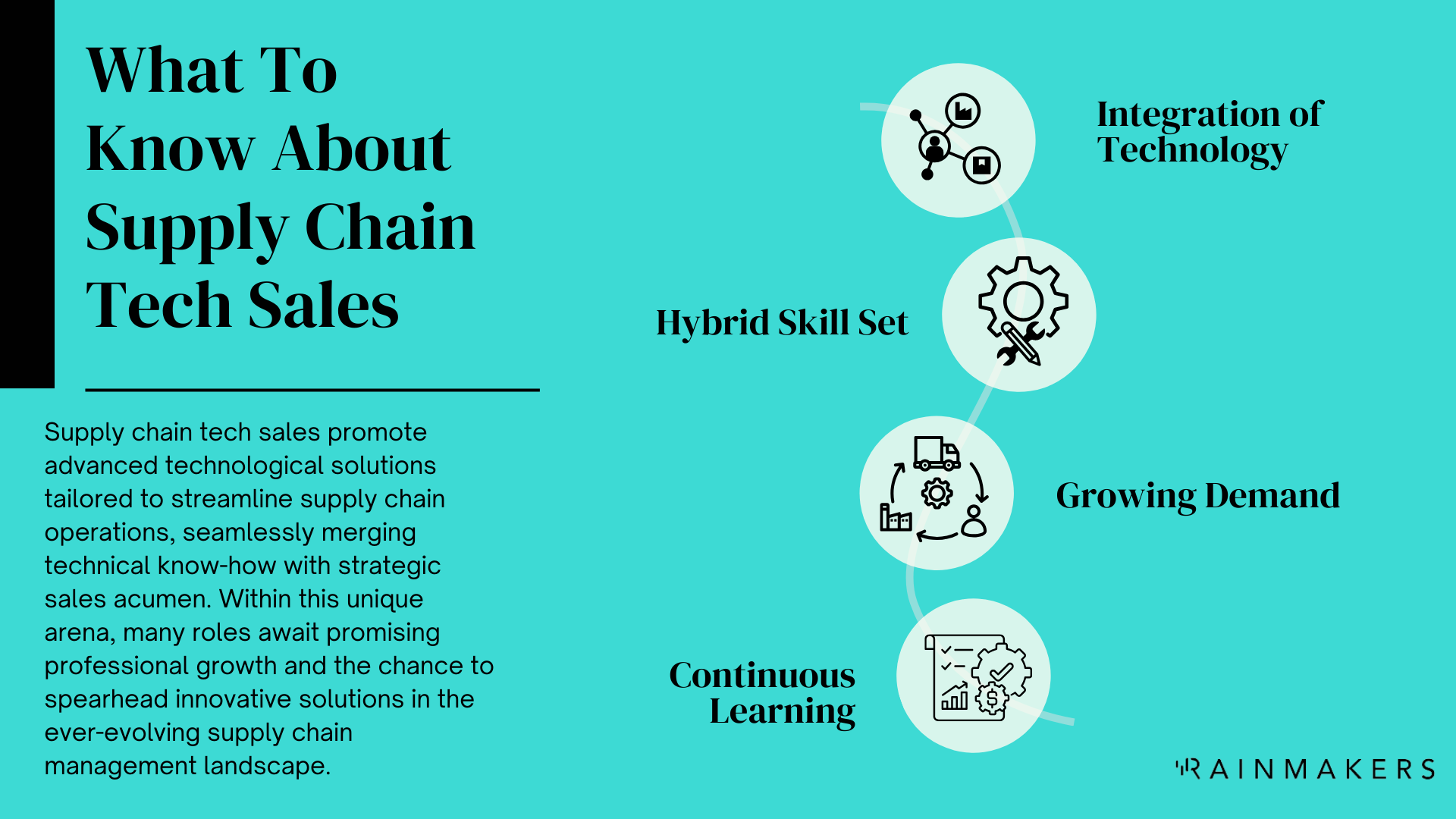
In today’s fast-paced business environment, integrating technology has become imperative for companies striving to maintain a competitive edge. As organizations across industries increasingly embrace digital transformation, the demand for skilled tech sales professionals within the supply chain sector has surged dramatically.

This comprehensive guide is crafted to provide valuable insights and strategies tailored to job seekers and employers. Whether searching for a job or recruiting top talent, this guide equips you with the knowledge and resources needed to thrive.

Endless Opportunities

Supply chain tech sales incorporate various roles, from Sales Development Representatives to Account Executives and Sales Engineers. These positions characterize a unique blend of technical proficiency, industry expertise, and sales intelligence.

According to recent industry reports, the demand for tech sales professionals in the supply chain sector is projected to grow at an annual rate of 7.3% over the next five years, significantly outpacing the overall job market growth rate of 4.2%.

Sales roles serve as the driving force behind innovation, efficiency, and industry advancement. As construction companies eagerly adopt digital solutions to optimize their operations, the demand for proficient sales professionals in this sector has surged.

Check out the most sought-after jobs in construction tech sales, illuminating the responsibilities, qualifications, and promising opportunities that define each role.

  1. Sales Development Representative (SDR): SDRs are the frontline champions of a company’s sales efforts, responsible for drumming up and qualifying leads, launching outreach campaigns, and nurturing connections with potential clients. In construction tech sales, SDRs are pivotal in spotting opportunities for technology adoption within the industry. They need strong communication skills, resilience, and a solid grasp of construction processes and challenges.
  2. Account Executive (AE): AEs are relationship builders tasked with understanding clients’ needs, pain points, and aspirations and tailoring solutions to meet them. In construction tech sales, AEs collaborate closely with construction firms to showcase how technology solutions can enhance project efficiency, cost-effectiveness, and overall outcomes. They require a mix of sales savvy, industry know-how, and the ability to articulate technical concepts clearly and persuasively.
  3. Sales Engineer: Bridging technical expertise with sales finesse, Sales Engineers provide comprehensive product demos, technical consultations, and support throughout the sales journey. In construction tech sales, they’re instrumental in illustrating the functionality and advantages of technology solutions, addressing client queries, and ensuring seamless integration into existing workflows.
  4. Implementation Specialist: Implementation Specialists oversee the smooth deployment and integration of tech solutions within client organizations. In construction tech sales, they collaborate closely with clients to understand their unique needs, develop tailored implementation plans, and offer training and support for successful adoption
  5. Customer Success Manager: Dedicated to ensuring clients’ long-term satisfaction and success, Customer Success Managers advocate for their needs and drive ongoing value from tech investments. They excel in interpersonal skills, problem-solving, and a genuine commitment to client happiness.
jobs in supply chain sales

Tips for Job Seekers

Job seekers looking to excel in supply chain tech sales should leverage their technical expertise, industry knowledge, and sales prowess.

According to LinkedIn’s analysis of job postings, the most sought-after skills for supply chain tech sales roles include proficiency in data analytics, software solutions, and customer relationship management (CRM) platforms.

Additionally, networking plays a crucial role in job search success.

Several key trends are reshaping the supply chain tech sales landscape as technology evolves. According to a report by Deloitte, 69% of supply chain executives believe that digital transformation will significantly impact their operations in the next two years.

Artificial intelligence (AI), machine learning, and data analytics are revolutionizing sales strategies, enabling companies to leverage predictive insights and optimize their supply chain processes for greater efficiency and cost-effectiveness.

supply chain recruiting company

Salary, Compensation, Bonuses

Understanding salary expectations and compensation structures is vital in construction tech sales, where various factors such as experience, location, company size, and education significantly impact pay. Key points to consider include:

  • Base Salary: Typically forms the foundation of compensation packages.
  • Commissions: Additional earnings based on sales performance.
  • Bonuses: Rewards for achieving predetermined targets or milestones.
  • Benefits: Additional perks include healthcare, retirement plans, and stock options.

Average salaries for roles like Sales Development Representative range from $40,000 to $60,000 per year, while Account Executives can expect between $60,000 and $100,000 annually. Effective salary and compensation negotiation is paramount for job seekers and employers.

Candidates should research industry standards and highlight their value proposition, while employers must offer competitive packages aligned with market trends and candidate expectations. Ultimately, successful salary and pay negotiation in construction tech sales requires a balanced approach that prioritizes mutual success and industry norms.

Data from the Bureau of Labor Statistics indicates that the median annual wage for sales engineers, a prominent role within the supply chain tech sales domain, is $103,900, surpassing the median salary for all occupations.

Additionally, commission-based structures and performance incentives provide top-performing tech sales professionals with the potential to earn well into the six-figure range.

find top sales talent

Challenges and Opportunities for Employers

Attracting and retaining top talent in the supply chain tech sales arena presents significant challenges for employers. A survey conducted by McKinsey & Company found that 83% of supply chain executives consider talent shortages to be one of the most significant barriers to achieving their strategic objectives.

Additionally, with the rise of remote work and virtual sales environments, adapting to changing recruitment strategies and embracing digital platforms has become imperative for companies seeking to remain competitive in talent acquisition.

Employers seeking to attract and retain top talent in supply chain tech sales should prioritize fostering a culture of innovation and continuous learning. According to a survey by Glassdoor, 72% of employees cite opportunities for career advancement as a key factor in job satisfaction.

Comprehensive training and professional development programs can enhance employee engagement and retention and empower sales teams to drive business growth and success.

Work With Rainmakers

Are you ready to dive into the thriving supply chain tech sales field? Rainmakers is your partner in unlocking the potential of this dynamic industry.

Whether you’re seeking your next career move or looking to hire top talent, we’re here to guide you every step of the way.

cyber security recruiting services

Linking Sales Talent with Cybersecurity Organizations

In an era where digital threats loom larger than ever, companies’ need to fortify their defenses with effective cybersecurity solutions has skyrocketed.

At Rainmakers, we specialize in connecting companies with the industry’s most skilled sales talent—individuals who understand the nuances of cyber threats and communicate the value of sophisticated cybersecurity solutions.

The Critical Role of Skilled Sales Professionals

Knowledge of the complex world of cyber threats requires a unique blend of expertise. Beyond a deep technical understanding, it demands sales professionals who practice translating the critical importance of cybersecurity measures into strategic business advantages.

Our mission is to connect your company with sales professionals with this rare combination of skills, ensuring your business’s digital assets are robustly protected against the dynamic threats of today and tomorrow.

Types of Roles We Fill
Our platform revolutionizes how sales professionals engage with the job market, especially in the dynamic cybersecurity sector. You attract top cybersecurity companies needing your skills by showcasing your successes and setting your own job preferences. This then enables cybersecurity companies to find you.

Explore the variety of roles we specialize in connecting you with:

cybersecurity sales jobs

Our Value Proposition

Rainmakers stands out among traditional recruiting agencies by matching your company with sales professionals who boast a proven track record in the cybersecurity domain.

Our extensive vetting process rigorously evaluates candidates for the necessary certifications, in-depth industry experience, and an intimate understanding of the cybersecurity challenges facing businesses today.

This ensures that the professionals we connect you with are qualified and poised to impact your sales and security strategies from day one substantially.

Challenges, Learning, and Strategic Impact

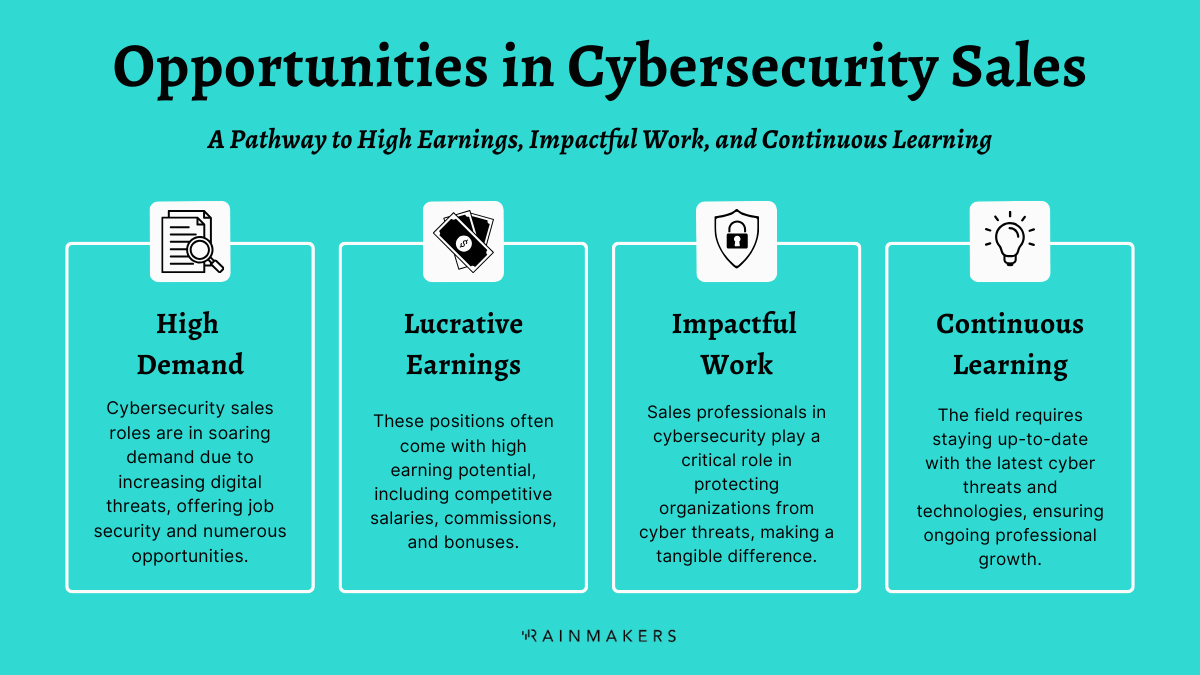
Cybersecurity sales careers are at the forefront of the tech industry, blending the intricate worlds of technology, strategy, and customer interaction. These positions are characterized by a fast-paced environment and the need for continuous personal development, making them a perfect match for those passionate about making a difference while advancing their skills.

Here’s what sets cybersecurity sales roles apart:

  • Cybersecurity sales jobs are situated at the crossroads of technology, sales, and security, offering a unique career path that is both challenging and rewarding.
  • These roles demand a commitment to staying updated on the latest cyber threats and defense strategies, ideal for individuals naturally inclined towards continuous learning and adaptation.
  • Professionals in this field can significantly influence the security posture of organizations, thereby contributing to a safer digital world.
  • The job involves creative problem-solving and strategic thinking, as salespeople customize solutions to meet each client’s unique needs.
  • This customization and solution-based selling approach increases job satisfaction and encourages innovative thinking and personal growth within the tech industry.

Why Cybersecurity Sales Is Your Next Career Milestone

If your passion lies at the intersection of sales and cybersecurity, welcome to your next big opportunity. The cybersecurity sales landscape is bursting with potential for significant career advancement, competitive compensation, and the chance to play a crucial role in safeguarding the digital frontier.

This career path offers substantial financial rewards, including competitive salaries and performance-based incentives, and the profound satisfaction of contributing to protecting essential digital infrastructures across industries.

Career and Professional Growth

At Rainmakers, we’re not just about connecting you with your next job; we’re invested in your long-term career success in the cybersecurity industry. Beyond placement, we’re committed to your ongoing development as a cybersecurity sales powerhouse, providing the resources you need to stay ahead in this fast-paced field.

  • Exclusive Job Opportunities: Access top-tier positions within the most esteemed cybersecurity companies.
  • Bespoke Job Matching: Our service aligns your specific skills and ambitions with roles that challenge and grow your professional capabilities.
  • Professional Development Resources: Benefit from comprehensive support, including certification guidance and the latest industry insights, to keep you at the forefront of cybersecurity sales.
  • Cutting-Edge Sales Strategies: Stay updated with innovative sales techniques and technologies that enhance your effectiveness and marketability in cybersecurity.
best sales recruiters

About Rainmakers

Our mission at Rainmakers is to create powerful synergies between the brightest minds in cybersecurity sales and the most forward-thinking companies. Our team, deeply rooted in cybersecurity and sales, is dedicated to understanding and addressing the unique challenges and aspirations of employers and job seekers in this sector.

Sign-Up Now!

For Employers: Share with us the qualities of your ideal cybersecurity sales candidate. Our tailored matching process is designed to efficiently identify professionals who meet and exceed your expectations, ensuring a perfect synergy between your company’s needs and our candidates’ expertise. Sign-up now!

For Job Seekers: Begin by crafting your profile, detailing your professional achievements and career objectives. Our targeted approach ensures that you’re matched with positions that align with your skills and propel you toward your long-term career goals in cybersecurity sales. Sign-up now!